Education stakeholders in Lagos State on Friday called for a comprehensive review of school discipline frameworks, stronger parental involvement, increased deployment of guidance counsellors and clearer alternatives to corporal punishment, as policymakers, educators, students and civil society leaders gathered at the Lagos Marriott Hotel, Ikeja, for a high-level policy roundtable on school discipline.
The event, organised by the Ajoke Ayisat Afolabi Foundation (AAAF) with support from SIFAX Group, focused on the theme: “Assessing the Impact of Banning Corporal Punishment on Discipline in Schools: Exploring Alternative Strategies for Managing Student Misconduct.”
At the heart of the deliberations was a growing concern among education stakeholders that while the ban on corporal punishment aligns with child protection principles, schools need clearer operational guidelines and stronger institutional support to manage student behaviour effectively.
Declaring the roundtable open, Dr Taiwo Afolabi, Chairman of SIFAX Group and Chairman, Board of Trustees of AAAF, represented by Oliver Omajuwa, Deputy Director, Strategy and Operations, SIFAX Group, said discipline remained fundamental to educational success and national development. He noted that the conversation was not simply about policy but about safeguarding the future of children, strengthening teachers’ confidence and building a society anchored on responsibility and character.
According to him, schools must be environments where “children can learn in safety, teachers can teach with dignity, and discipline serves as a pathway to character, not fear; responsibility, not rebellion; growth, not resentment.” He urged stakeholders to approach the conversation with open minds and focus on practical solutions that put children’s best interests at the centre of educational reforms.
A major highlight of the event was the presentation of findings from a statewide policy review conducted by AAAF across Lagos State’s five educational divisions. The research involved 451 students, 42 school leaders and teachers, and 150 students participating in focus group discussions across 15 schools.
Presenting the findings, AAAF reported that although most students surveyed believed their schools maintained relatively good levels of discipline, many educators expressed concerns about inadequate guidance on disciplinary alternatives following the ban on corporal punishment. The report identified gaps in policy implementation, teacher capacity, institutional support and stakeholder engagement.
The study recommended greater policy clarity, continuous teacher training, development of school-level disciplinary frameworks, stronger parental participation and periodic policy reviews to address emerging realities in schools. It also proposed structured escalation procedures for handling offences, ensuring that disciplinary measures are proportional to specific misconduct.
Lagos State Commissioner for Basic and Secondary Education, Jamiu Tolani Ali-Balogun, who attended the event, stressed that discipline begins at home and argued that many challenges facing schools reflected wider societal problems rather than failures within the education sector.
The commissioner maintained that while policies remain important, successful implementation depends largely on cooperation from parents and communities. He lamented what he described as the growing disconnect between parents and schools, noting that many parents fail to respond when invited to discuss behavioural issues concerning their children.
“We must create society first. It is not just about policy. Parents are critical to discipline,” he said while urging families to take greater responsibility for the moral upbringing of children.
One of the most engaging sessions came from students who participated in AAAF’s essay competition on school discipline. The students challenged stakeholders to rethink traditional approaches to punishment and focus on developing character, responsibility and self-control.
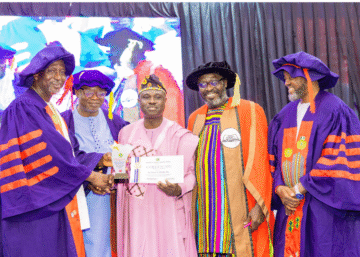
Winner of the competition, Iwala Olachiwa Sharon, argued that true discipline should help children make the right choices even when no authority figure is present. She advocated guidance and counselling, restorative justice measures and clear disciplinary codes rather than physical punishment.
On the policy side, experts from the education sector, civil society organisations, school administrators and teacher unions highlighted the urgent need for stronger support systems in schools. They advocated increased recruitment of guidance counsellors, specialised teacher training and more structured collaboration between parents, schools and government agencies.
Executive Secretary of the Lagos State Domestic and Sexual Violence Agency, Lola Vivour-Adeniyi, argued that corporal punishment often fails to achieve genuine behavioural change and called for discipline strategies that emphasise communication, guidance and accountability. She described physical punishment as a “lazy approach” that may create fear without necessarily building character.
The roundtable concluded with broad consensus that the future of school discipline in Lagos must be built on shared responsibility among government, schools, parents, civil society organisations, and students themselves. Participants agreed that sustainable reform would require clearer disciplinary procedures, stronger safeguarding mechanisms and robust stakeholder engagement.