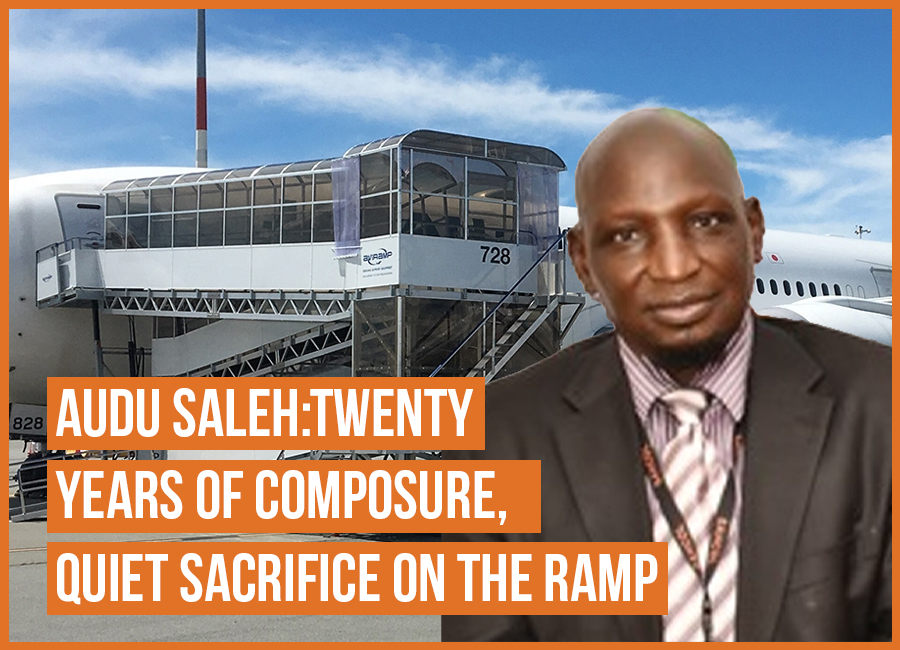
He was slapped at a check-in counter, thanked the man, and was slapped again.
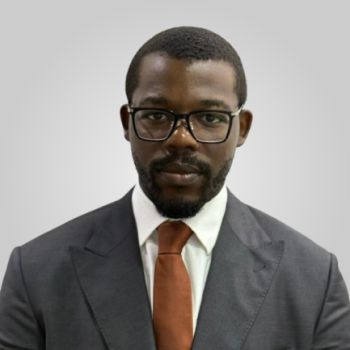
In this month’s Milestone Spotlight, Audu Saleh looks back on nearly twenty years at SAHCO, from management trainee to the Station Manager in Kano, and on what the ramp asked of him along the way.
The queue would not end. His colleague had gone home sick, the internet was down, and more than 150 passengers waited to be checked in by hand, by one man, at one counter. “I felt the weight of every single person waiting,” he says.
Then one of them stepped out of the line and slapped him.
He stayed where he was and thanked the man. The passenger slapped him again. He left the counter, took the time he needed, and came back to finish the job. He gives credit elsewhere. “The training I had on customer service and self-control helped me during that difficult moment.”
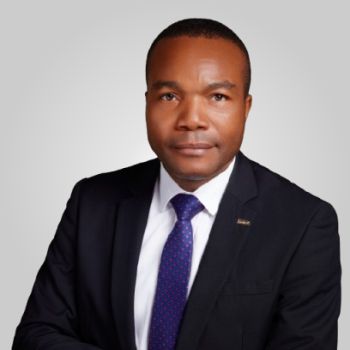
Audu Saleh was a management trainee. Today he runs the station at Kano.
Nervous but exciting
He came to SAHCO in October 2006 through a competitive entry process, after years with smaller firms where he had built a name for, in his own words, “attention to detail, safety, excellence and team coordination.” There was an application, an aptitude test, and rounds of interviews. They took him on and rotated him through everything: passenger services, load control, ramp, safety, training, cargo. By April 2008, he was a station manager.
He sums up his first day in two words. “Nervous but exciting.” He reported to the old SAHCOL office at the domestic wing of the Aminu Kano International Airport in Kano, and what struck him was the pace of the place. The aircraft turned around in thirty minutes. Tugs and belt loaders moved, he says, “like a choreographed dance.” Most of the day went on shadowing and reading standard operating procedures. One line came at him often enough to lodge. “In SAHCO, safety is not negotiable.”
Strict but fair
Alhaji Oluropo Owolabi was the MD/CEO in those years and seats today on the board. “He is strict but fair.” When a turnaround went wrong, or the station ran short of hands, Owolabi would walk him back through the root cause without raising his voice, then through the fix. The lessons were about documentation, punctuality, integrity and process discipline, and about what those things protect: lives, reputation, and longevity.
Underneath all of it came the one Saleh repeats most. “He made me a better leader by showing that composure under pressure is a skill, not just a personality trait.” He calls the mentorship fatherly and says he will remain grateful for it.
He had not been born calm. He had been taught.
The flight that would not come
The teaching met its match on ET941. Around 350 passengers had checked in and pre-boarded at Kano, waiting on an aircraft from Addis Ababa that bad weather sent to Abuja instead. The departure had been set for 1335. They waited until 2300. The next day the same passengers checked in again, boarded again, and the aircraft diverted again. It came in around 0400 and left the day after that.
“I could only imagine the customer complaints, the frustration, the tension,” he says. He kept his team steady so his team could keep the terminal steady. “We stayed with them, we organised, and we made sure everyone understood the situation.” Ethiopian Airlines’ manager commended them afterwards. What Saleh took from it, he states plainly. “Crisis isn’t about having all the answers. It’s about showing up, staying composed, and leading by example.”
Ninety minutes instead of three hours
Not every test hurts. When the pandemic emptied the skies, Ethiopian Airlines stripped the seats out of passenger aircraft and flew them full of cargo instead. Nobody at Kano had handled that before, so they built something. A conveyor brought cargo down onto pallets already waiting on dollies at the ramp. Three hours on the ground became ninety minutes or less. The airline adopted the method at other stations. Kano became a reference point, and contracts in Lagos and elsewhere followed. He still smiles about it, and about what it proved. “When we think outside the box, we don’t just serve clients, we set standards.”
What the title does not show
The years took their payment quietly. He bought diesel out of his own pocket to keep operations running, and spare parts to get equipment back on the line. He forfeited leave. He slept at the airport.
“People see the title, but they don’t see the missed birthdays, the school events I never attended for my children, and the countless public holidays I spent on the ramp instead of being with my family.”